5 Minutes That Will Save You 5 Hours
Read Time: ~3 min
Every busy supervisor I’ve ever worked with says some version of the same thing:
“I don’t have time for the relationship stuff. I’ve got actual work to do.”
I used to say it too.
And it cost me in turnover, conflict, and hours spent cleaning up messes that better relationships would have prevented entirely.
Eventually I started looking at it differently.
Not as a leadership principle.
As math.
What Poor Relationships Actually Cost You
When connection with your team is low, you’re already paying the price. You just don’t recognize it as a relationship problem.
You see it as “just part of the job.”
But think about what most supervisors absorb every week:
2–3 hours cleaning up miscommunication
5–10 hours per month managing unnecessary conflict
20–40 hours per quarter recruiting, onboarding, and retraining because of turnover
That’s not the cost of building relationships.
That’s the cost of not building them.
When supervisors invest even 30 minutes per week per employee in intentional connection, it often saves 3–5 hours per week in supervision overhead.
That’s not leadership theory.
That’s ROI (return on investment).
Why It Feels Like There’s No Time
Most supervisors don’t skip relationship work because they’re lazy.
They skip it because the return isn’t immediate.
When you solve a problem, you see the result right away.
When you invest five minutes in a real conversation with a team member, the payoff shows up later:
Problems surface earlier
Conflict gets addressed sooner
Miscommunication drops
People stay longer
Connection creates a flywheel.
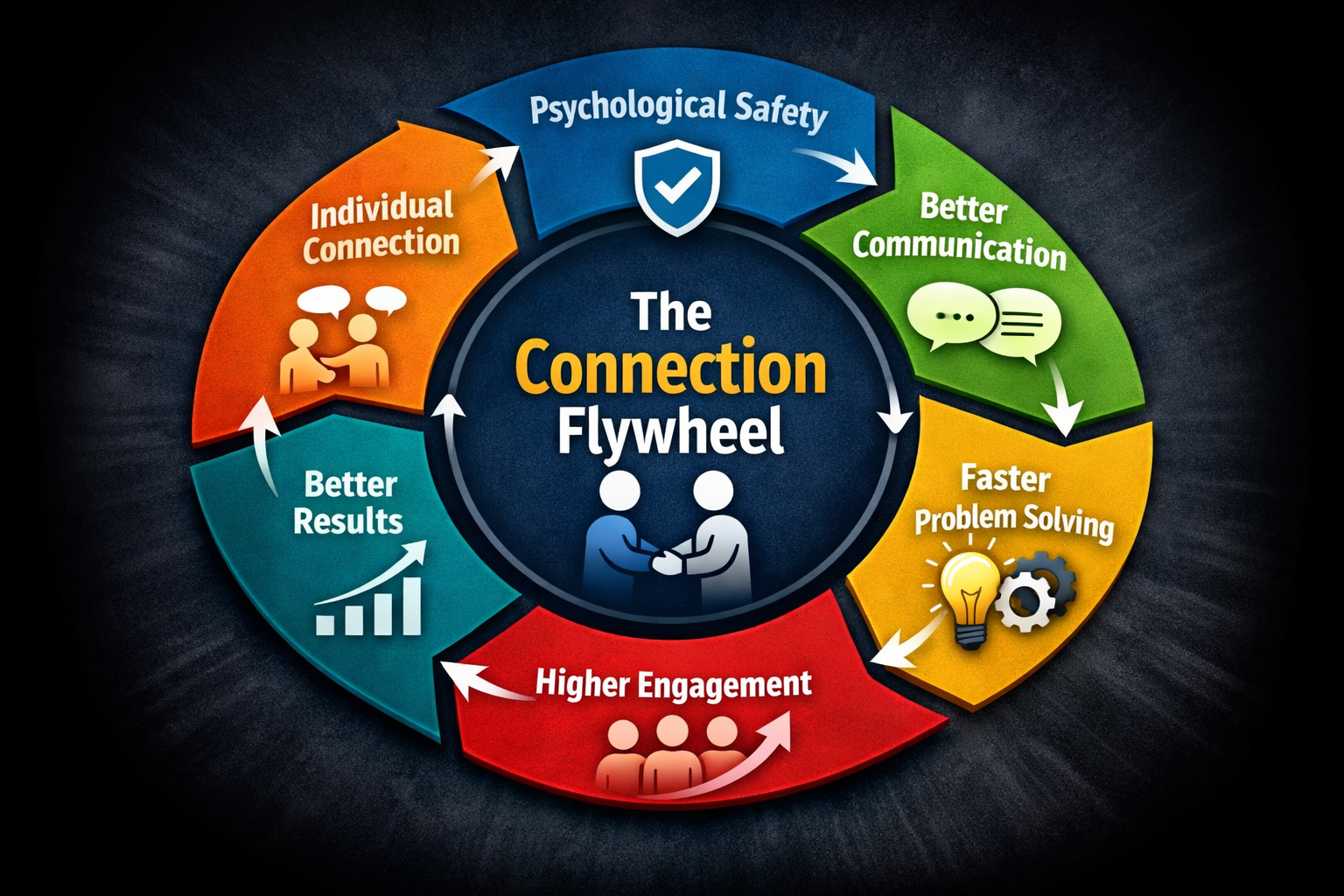
The first turn of the flywheel is the hardest.
But once it’s moving, it builds its own momentum.
The 5-Minute Entry Point
You don’t need a new program.
You don’t need a complicated culture initiative.
You just need to add five intentional minutes to meetings you’re already having.
Before you jump into the agenda, ask one real question.
Not “How’s it going?” that’s just a reflex.
Try something like:
“What’s felt most energizing for you this week?”
“Is there anything that’s been getting in your way lately that I should know about?”
“What’s something you learned recently that surprised you?”
Then do the part most supervisors skip.
Actually listen to the answer.
What Starts to Shift
According to Gallup research, managers account for 70% of the difference in team engagement.
Within 30–60 days, you’ll begin noticing subtle but powerful changes.
People will start telling you things before you ask.
More questions and ideas will surface in meetings.
Problems will come to you earlier.
Team members will start helping each other without prompting.
These aren’t soft outcomes.
They’re operational ones.
They represent hours you get back, conflicts you avoid, and turnover that never happens.
One Objection Worth Addressing
Some supervisors tell me:
“This feels fake when I try to switch into connection mode.”
Authenticity doesn’t mean acting the same in every situation.
It means being genuinely yourself while adapting to what the moment requires.
Your values don’t change.
Your expression of them does.
A system, even something as simple as a five-minute opening question, doesn’t make connection inauthentic.
It makes connection consistent.
Your Move This Week
Pick one recurring meeting.
Add five minutes at the beginning.
Ask one real question.
Listen to the full answer before moving to the agenda.
Do it for three weeks in a row.
Then see if the dynamic in that relationship hasn’t shifted.
Because here’s the truth most supervisors learn the hard way:
The relationship stuff is the actual work.
If you want practical tools for building stronger supervisors in your organization, you can schedule a strategy conversation with me:
👉 Schedule a Strategy Conversation
This isn’t a sales call.
It’s a focused conversation to understand what’s really happening and whether I’m the right person to help.